



The Latest News from PA Chapter of APA…
A Recipe for Heritage-Based Planning: Comp Plans, Placemaking and Partnerships
 April 1 from 12:00 pm – 1:00 pm
While mandated to be addressed by the MPC, historic resources and heritage planning can often be given little attention in comprehensive plans as compared with other planning topics. In Chester County, historic resources and heritage planning is on equal footing with other policies in Chester County’s comprehensive plan, Landscapes 3, as one of six planning topical areas. Learn how historic resources and heritage planning policy is being put into action and especially the critical role of partnerships with municipalities and organizations to create tools, programs, and projects that effectuate policy and actions and can be used for municipal planning, local heritage economy development, and preservation of lands and resources. A theme throughout the session is “place preserving as place making”. A case study of the Brandywine Battlefield Task Force partnership and Heritage Interpretive Plans and implementation show a type of successful approach. This session will focus on various initiatives that are replicable and will help you build your own recipe book. Other places can look to a similar strategy for their Comprehensive Plan and implementation. County, local, and non-profit/consultant presenters provide a varied and broad-based perspective.
Deadline to register is March 31.
APA PA Annual Conference
- Save the Date for the APA PA Chapter Annual Conference: Forging the Next 250 Through Preservation, Innovation, and Collaboration, which will take place from October 18 -20, 2026 at the Wind Creek Bethlehem.
- Call for Presenters is open! Proposals are being accepted online only via the Chapter website. The deadline to submit your proposals is Friday, March 13, 11:59 PM. Traditional and non-traditional sessions are being accepted. For more information.
- Sponsors, Exhibitors & Advertisers: Secure your support for the Annual Conference. The conference presents an exceptional opportunity for organizations like yours to showcase your expertise and capabilities to planning professionals and policymakers from across the Commonwealth. For more information.
Mid-Atlantic Planning Collaboration: Land Use Decisions for Healthy Landscapes
March 12 from 12:00 pm – 1:00 pm
The well-being of the Chesapeake Bay depends on the health of the lands that make up its watershed. As communities within the region continue to grow or intensify their activities, the demand for land and resources can add pollutants to the system and put our waters and habitats at risk. Many of these lands support not only water quality but also provide other economic, recreational, cultural and ecological benefits we do not want to lose. That’s why the Chesapeake Bay Watershed Agreement was recently updated with a revised Healthy Landscapes goal and outcome related to land use planning. Come hear what planners should know about these changes, how your community can be involved and what new or updated data and tools are available to support your communities goals and future planning. For more information.
Introducing our Officers: Christina Arlt, AICP, Vice President
Christina Arlt, AICP leads the Planning & Communications group at McCormick Taylor’s Philadelphia office. She manages planning and public engagement projects for clients like SEPTA, PennDOT, Lancaster County, the City of Philadelphia, and NJDOT. Prior to starting at McCormick Taylor in 2019, Christina worked for nearly a decade at the Delaware Valley Regional Planning Commission (DVRPC), where she coordinated DVRPC’s Classic Towns, Municipal Outreach, and Strategies for Older Suburbs programs. Christina also worked in Planning & Zoning for Warwick Township in Bucks County and spent a year as a Fulbright English Language Teaching Assistant in Hamburg, Germany.
Christina obtained her Master of City Planning with a focus on Land Use and Environmental Planning at the University of Pennsylvania, where she also obtained a Certificate in GIS. Her undergraduate degree is in Urban & Environmental Studies from Franklin & Marshall College. In addition to the American Planning Association Pennsylvania chapter, Christina is involved with WTS-Philadelphia, an organization that supports women in the transportation industry. She also teaches a class for first-year Master of City Planning students at the University of Pennsylvania. In her spare time, she enjoys reading, traveling, and attending Cookbook Club at her local library.
Updated Tool for Understanding Communities: PennEnviroScreen
By Justin Dula, AICP
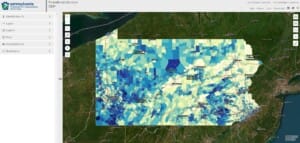 Are you looking for a tool with Pennsylvania specific data to help understand and compare communities? The Pennsylvania Department of Environmental Protection (DEP) released the final Environmental Justice (EJ) Policy on January 3, 2026 and with this release comes an update of the PennEnviroScreen tool. By using PennEnviroScreen, planners can help better understand community demographics and burdens. This can be useful even beyond an explicit EJ context, as PennEnviroScreen is data-rich: it includes great amounts of of Pennsylvania specific data Moreover, it makes comparisons between parts of Pennsylvania as opposed to national comparisons. The data is all publicly available for planners to use in custom applications as well.
- Have you ever been working on a grant application and wanted to put comparative numbers in your community needs statement?
- Have you been working on a public outreach plan and wondered if you needed to include language interpretation or translation services?
- Have you wanted to make a community comparison to another town in Pennsylvania, but aren’t sure which communities face similar issues?
The PennEnviroScreen tool can help in all these scenarios and more!
PennEnviroScreen quantifies and visualizes disproportionate environmental effects on vulnerable populations. PennEnviroScreen relies on two categories of 32 indicators. These indicators are broadly separated into Pollution Burden and Population Characteristics. All characteristics are converted to percentile scores based on Pennsylvania-specific data. The indicators are combined into a final PennEnviroScreen score, but each indicator is also available separately and often looking at individual indicator data is useful. All data is shown at the Census Block Group level across Pennsylvania, showing granular data that can help planners target specific projects within their city, township, or borough.
There are several ways planners can utilize this tool. Planners can get a better understanding of communities:
- by visiting the PennEnviroScreen tool [https://gis.dep.pa.gov/PennEnviroScreen/].
- by downloading DEP created data on the Department’s Open Data Portal for custom GIS applications.
- by reviewing the PennEnviroScreen methodology to better understand the indicators, to find original data sources, and even to spur further planning questions.
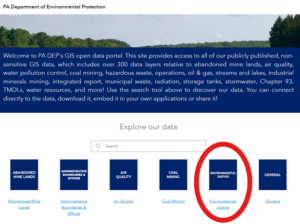
PennEnviroScreen Tool
The native application allows for quite a few customized views and robust data analysis for planners who are looking to get a quick snapshot of data in their community. When you enter an address or municipality name in the search bar, the tool zooms to that point. By clicking on the map, an “Identify Results” pane displays results for all of the layers that you have open. PennEnviroScreen also includes many reference layers to relate the Block Group data to county, municipal, school district, legislative, zip code, and other boundaries. This can help planners narrow in on areas of particular concern in the communities in which we work. By clicking on the highlight and zoom feature, you are taken to the extent of the area that is being described, be it census block group, municipality or more.
To get to the information from the use cases above, you can open particular layers to see more information. You can focus on those indicators where your community is seeing need to produce a need statement with percentile quantification for a grant application. You can identify linguistic isolation to see if there is a need for language translation or interpretation. You could also zoom back out to compare your community with others in Pennsylvania on any individual factor, be it asthma or abandoned mine sites.
Downloading PennEnviroScreen Data
For planners who have GIS capabilities and wish to produce custom maps, all of the layers created by DEP are available on the Department’s Open Data Portal. Planners can download the data and incorporate it into existing county or municipal mapping tools.
Original Data
For planners who want to dive very deeply into the original data sources, the PennEnviroScreen methodology talks about each indicator and links to the data source used. It also describes the rationale for including the data and potential future data sources to consider in future updates. Some of these sources may be available for your municipality!
As the landscape around environmental justice changes on the federal level, Pennsylvania DEP remains committed to supporting communities living in environmental justice areas. DEP is eager to work with the planning profession to help improve PennEnviroScreen in future iterations! The data itself does not point to possible actions that would decrease inequality. But we have found in many contexts that the visibility of this kind of data can spur important dialogue about what solutions might exist. We are eager to learn from the planning profession about ideas or possibilities to create more just outcomes for people and communities. If you are using the tool and find it helpful, collecting case studies helps make the case for continued investment into PennEnviroScreen. If you have questions or suggestions, you can always enter them into the feedback button on the upper right of PennEnviroScreen, but also don’t hesitate to reach out the DEP Office of Environmental Justice team at RA-EPOEJ@pa.gov.
Opportunities for Giving
Each year the Chapter offers a scholarship to support individuals seeking funds for academic degree programs, internships, and professional development activities. If anyone would like to contribute to the Chapters Scholarship fund donations can be made online. We accept all major credit cards, and you can also send a check. Please make your check payable to “PA Chapter of APA Scholarship Fund” and mail it to P.O. Box 4680, Harrisburg, PA 17111.
Communication and Membership Committee
We are looking for volunteers to contribute articles for our monthly E-News. If you are interested or would like more information, please contact us.
Legislative Committee Update
By Betsy Logan
Several bills are gaining traction in the State House & Senate related to housing affordability and reducing barriers to housing. Currently, five House Bills have been introduced and are in committee. A brief summary and links to the bills are provided below:
- Legalizing ADUs (HB2186 Housing Committee): Allows ADUs by right in single-family zoning districts; municipalities may add reasonable restrictions.
- Municipal Occupancy Reform (HB2109 Housing Committee): Prohibits local occupancy limits on unrelated people unless directly tied to health, safety, or fire codes.
- Eliminating Parking Minimums (HB2155 Housing Committee): Prohibits parking mandates to allow developers to build parking at levels that more accurately reflect demand rather than outdated formulas.
- Creation of a Housing Council (HB2192 Housing Committee): Creates a Commonwealth Housing Council to coordinate housing policy across state agencies to develop a uniform set of housing goals, benchmarks, and priorities every 5 years.
- Duplex/Triplex/Fourplexes on Single-Family Lots (HB2185 Local Gov Committee): Requires municipalities (5,000+ population) to permit duplex, triplex, and quadplex housing in single-family residential districts.
Additional proposals circulating include TODs incentives, grant programs, pre-approved housing plans, annual housing targets, property tax abatement, regulatory streamlining and enforcement reform. The Legislative Committee with support from 10,000 Friends has been reviewing and providing feedback on these legislative items.