
Posted on August 26, 2021
Why You Should Know SDOH
Community Engagement Education & Training Healthy Communities TechnologyThe time you spend with doctors, nurses, and other care givers has surprisingly little to do with your overall health and wellness. Most of your health is rooted in your social and physical environment: your access to healthy food or a livable wage, the presence/absence of stressors, how easy it is for you to get out and move around, the social cohesion of your neighborhood, the shops and services you can both get to and afford. These factors are often called Social Determinants of Health (SDOH), and their power is considerable: your zip code can be a greater predictor of wellness than your genetic code.
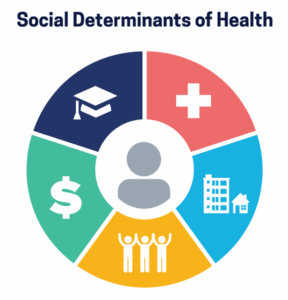
Amazingly for those in planning, this means that we, as designers of communities, often have as much or more potential to drive positive health outcomes as the people who write prescriptions and fix broken bones do. Connections between community and health are clear in planning for recreation, transportation, and hazard mitigation, but the profession’s role in public health can be defined even more broadly through community development activities.
This is a key way in which planners can act to address inequality. As healthcare advisory firm Healthbox recently noted, “Research shows that race, place, and health are deeply intertwined.” For example, racial disparities are often marked by pervasive and drastic differences in housing stock, economic opportunity, educational access, environmental contamination, and many other factors that affect wellbeing so much so that average life expectancy declines.
You can explore this in your own area using the National Center for Health Statistics’ interactive life expectancy map. It is not uncommon for life expectancies, when mapped by zip codes, to vary by 10 years or more in the same community. The image below shows these disparities across a broad swath of central Pennsylvania.

Planning within the SDOH framework is both an opportunity to directly affect lives and a challenge to tackle both design on the ground and systemic, structural roots of disparities. Good places to learn more are the PA Chapter’s Healthy Communities Task Force, the US Dept. of Health & Human Services’ Social Determinants of Health webpage, and the Urban Institute’s Social Determinants of Health webpage.