
Posted on June 2, 2024
From Juneteenth to Pride Month: Addressing Historic Inequities in Housing and Zoning
Community Engagement Education & Training Governance / Working In PlanningBy Betsy Logan, AICP
June marks two noteworthy events in the United States’ history of discrimination and inequity. Each year, Juneteenth, now a federal and state holiday, commemorates the end of slavery in the United States on the 19th of June. Pride Month celebrates lesbian, gay, bisexual, and transgender pride, commemorating the Stonewall riots of 1969. Both Juneteenth and Pride Month remind us that while progress has been made, a history of discriminatory practices, such as the impact of redlining on zoning districts, continues to affect equality and justice.
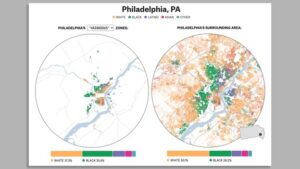
Philadelphia’s “hazardous” red lined zones compared to present-day segregation. Graphic: FiveThirtyEight and ABC News analysis. Image Article Source: Allen, T. 2022. Philadelphia’s redlining legacy persists. Axios Philadelphia.
As planners, June provides an opportunity to recognize how past planning policies and practices impact protected classes and their access to housing. A recent APA-PA Central Section training session explored the history of how redlining evolved into a zoning tool to segregate cities and exclude neighborhoods based on race. Adrian Garcia from the PA Human Relations Commission (PHRC) detailed the legacy of redlining and how it continues to influence fair housing and discrimination.
Understanding the impacts of exclusionary zoning is especially important when rewriting zoning ordinances, working on affordable housing projects, and implementing stronger design standards and revitalization projects that may affect neighborhood gentrification. The PHRC offers training and events for communities and organizations on Fair Housing, Bias, Discrimination, Equity, and Inclusion, workplace discrimination, and Civil Rights. The PHRC is also a valuable resource when considering zoning amendments or developments that could impact housing in a community. In addition to educating ourselves and our communities, planners can advocate for inclusionary zoning that adds affordable housing choices outside traditional city areas and promotes the reduction of concentrated areas of poverty.