Posted on September 28, 2023
Looking to the Future for Community and Professional Resiliency
ArchiveLooking to the Future for Community and Professional Resiliency
By Amy Evans, AICP
When planners talk about resiliency, we’re usually considering how well a community can bounce back from a given challenge. Building resiliency in this way usually involves identifying processes, programs, and data that support a community’s ability to prepare for and respond to a disaster or crisis efficiently and effectively.
In this mindset, we sometimes miss opportunities for baked-in resiliency that lay in how we know what to plan for in the future, methodologies that go well beyond 100-year floods, traffic counts, and population projections.
Collectively, these skills foster strategic foresight, or planning with foresight. A recent 2-page PAS Quick Notes document defines strategic foresight as “…making sense of the future, understanding drivers of change that are outside of one’s control, and preparing for what may lead to success or failure in the future.”
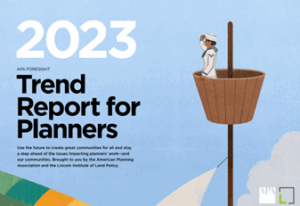 A recent article from APA dives into the skillsets planners need to plan well for the future – as well as remain professionally relevant. In many ways, practicing foresight is visioning in reverse. As author Patrick Sisson notes, where visioning starts with the present and leads to goals for the future, foresight “starts with the future and then reverse engineers what needs to happen today to get the most desirable outcome.”
Tools for planning with foresight include trend scanning, signal sensing, forecasting, sense making, scenario planning, and backcasting. For an example of what scenario planning can look like in Pennsylvania, check out our May 2022 article on transportation planning in York County in the face of uncertainty. Another great resource is APA’s Trend Universe site, maintained by APA Foresight.
Increasing planners’ capacity for strategic foresight can create agility, boost resiliency, and expand capacity for preparedness within communities – as well as ensure that planning itself is resilient to changing demands on the profession.