With this month’s focus on planning for health and wellbeing, it is worth looking at two sources of data that professional planners can use to inform comprehensive plans, community development activities, housing policies, neighborhood design, recreational facility planning, and more.
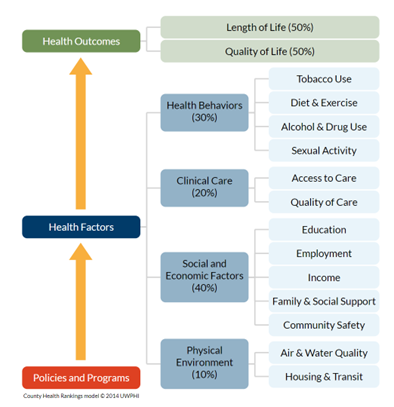
The Robert Woods Johnson (RWJ) Foundation maintains a comprehensive set of community health indicators for every US county. These County Health Rankings & Roadmaps combine data from many different sources into rankings for health outcomes (how healthy the community currently is) and health factors (community characteristics contributing to future health). These health factors include measures of the physical environment and social and economic circumstances that affect an estimated 50% of any given resident’s health. This is important to planners because we can directly influence many of these factors. It also offers an evidence-based approach to defining “quality of life,” something the planning profession often promises to improve but has difficulty systematically measuring.
A good place to start with the County Health Rankings is to explore Pennsylvania as a whole. From there, it’s easy to find a wealth of county-specific data. While you likely can obtain data from local sources that are more granular and/or cross-tabbed by gender, race, ethnicity, age, or other demographic factors, the RWJ ranking data provides a great first-look overview than can help you identify areas of community-wide concern and flag them for further investigation.
The County Health Rankings are useful in part because very few data compilations combine this range of sources into a user-friendly interface that promotes taking action on the data. One caution is to carefully review sources for the applicable date range and other caveats before drawing conclusions – the 2022 County Health Rankings, for example, include data from earlier years when more recent information is unavailable. The good news is that RWJ makes this metadata very easy to access. In fact, diving into the sources of rankings data can be a great way to identify little-known databases and dashboards on a variety of planning topics.
Community Health Needs Assessments are another good source of community data that planners often overlook. The Affordable Care Act requires that hospitals demonstrate overarching community benefit to maintain nonprofit status. An important component is the development of Community Health Needs Assessments (CHNAs) every three years. CHNAs are intended to drive strategic community initiatives addressing major health needs.
Of interest to planners, CHNAs focus not only on healthcare needs but also community stressors like rising home prices, food insecurity, violence, and trauma. CHNA methodologies vary by health care system but often combine extensive community polling with patient data on physical and behavioral health as well as social determinants of health. CHNAs are usually available online or by request to your local hospital system.
CHNAs demonstrate the impact of community stressors on individual wellbeing – stressors that planners often work to mitigate. This means that CHNA data can be used to make powerful statements about community need in our plans, to our elected leaders, and in the grant opportunities we pursue. If your community has a coalition of healthcare stakeholders, think about joining it. The potential partners you find there may be nontraditional, but it’s practically guaranteed that they’re trying to solve at least some of the same community challenges planners are.